
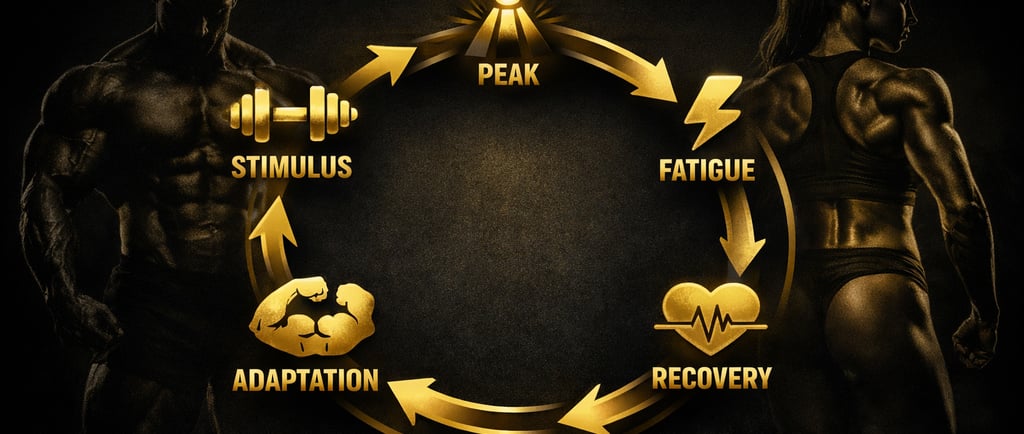
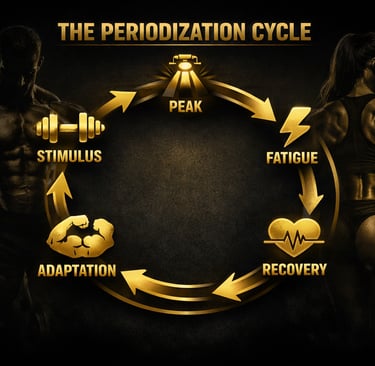
NB: Please click on each image in this article to expand to full view.
What is Periodization?
It is a systematic, planned variation of training & nutrition variables.
- Origin: Soviet sports science (Matveyev, Bompa) and adapted to modern resistance training
- Core principle: Stimulus and Fatigue and Adaptation and Peak
- In bodybuilding: Optimizes muscle size, symmetry, conditioning, and stage readiness on a specific date.
Periodization isn’t just “changing exercises.” It’s a structured timeline that manipulates volume, intensity, frequency, nutrition, and recovery to drive specific physiological adaptations while managing cumulative fatigue. In bodybuilding, the “performance peak” is a static stage appearance, not a 1 Repetition Maximum (RM) or race time, making timing everything.
Why Periodization is Non-Negotiable in Bodybuilding
- Prevents plateaus & overtraining
- Manages metabolic, neurological, & structural fatigue
- Aligns peak condition with competition date
- Enables progressive fat loss while preserving lean mass
- Replaces guesswork with measurable, adjustable programming
Without periodization, athletes either overtrain, under-recover, or miss their stage peak. Contest prep is a controlled stressor. Periodization dictates how stress is dosed, when it is reduced, and how recovery is scheduled. It is the difference between “looking good” and “peaking on Saturday night.”
The Periodization Hierarchy
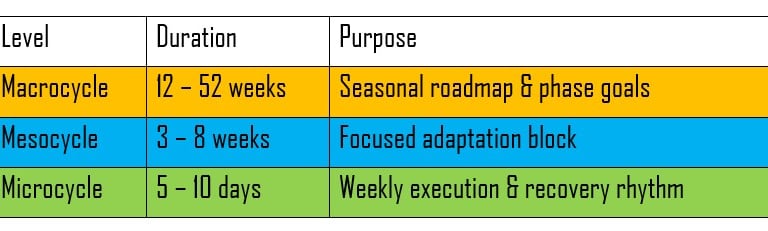
The mesocycle is the essential bridge. Think of it this way: The macrocycle sets the destination, mesocycles are the highway segments, and microcycles are the daily driving shifts. Ignoring any level breaks the chain. We’ll focus heavily on macro and micro, but always contextualize them within mesocycle blocks.
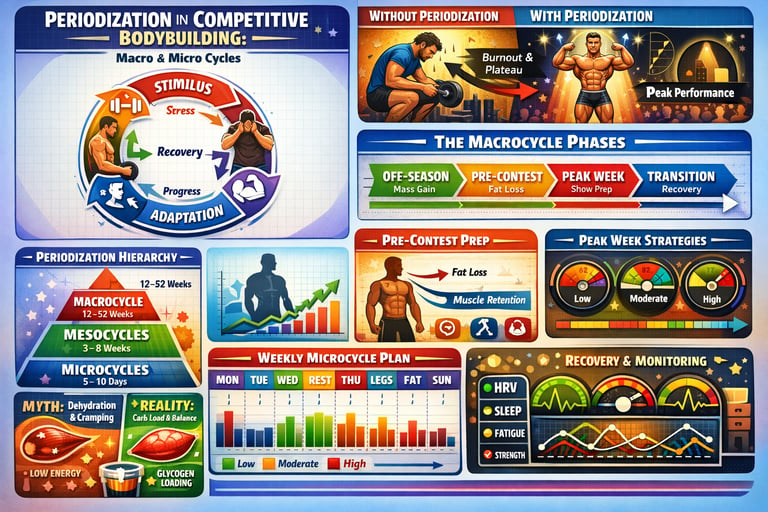
The Macrocycle – Your Annual Blueprint
- Typically 16–24 weeks for first-time competitors; 12–16 for veterans
- Four mandatory phases:
1. Off-Season / Mass Accumulation
2. Pre-Contest / Conditioning
3. Peak Week / Taper
4. Transition / Recovery
- Goal alignment drives every variable shift
The macrocycle is your master calendar. Every nutrition target, training split, cardio prescription, and recovery protocol maps to one of these four phases. The length depends on starting body fat, experience, and division. Rushing a macrocycle guarantees suboptimal conditioning or muscle loss.

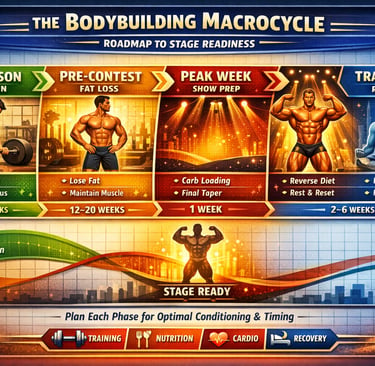
Macro Phase 1 – Off-Season / Mass Accumulation
- Duration: 4–12+ months
- Training: High volume (15–25+ sets/muscle/week), moderate intensity (65–80% 1RM), progressive overload
- Nutrition: +300–500 kcal surplus, protein 1.6–2.2g/kg, carb periodization around training
- Goal: Maximize lean tissue accretion, build strength foundations, address weak points
- Monitoring: Monthly photos, strength trends, waist circumference
This is where champions are built. The off-season isn’t “eat whatever” – it’s structured surplus with progressive overload. Volume drives hypertrophy, intensity preserves strength, and weak-point specialization prevents stage flaws later. Track waist-to-chest ratio to ensure lean mass > fat gain.
Macro Phase 2 – Pre-Contest / Conditioning
- Duration: 12–20 weeks
- Training: Moderate-high volume and taper, intensity maintained (Rate of Perceived Exertion, RPE 7–9), posing integration
- Nutrition: Progressive deficit (-300 to -700 kcal), high protein (2.3–3.1g/kg), carb/fat manipulation, strategic refeeds
- Goal: Fat loss while preserving muscle, enhance vascularity/definition, practice stage routine
- Monitoring: Weekly photos, strength maintenance, Heart Rate Variability (HRV), sleep, fatigue scales
This is the most fatiguing phase. The key is gradual calorie reduction, not crash dieting. Maintain intensity to signal muscle retention. Volume drops later as fatigue accumulates. Posing is not optional – it is metabolic training and stage rehearsal. Refeeds are periodized tools, not cheat days.
Macro Phase 3 – Peak Week
- Duration: 7 days pre-show
- Training: Light pump work, volume taper, posing only
- Nutrition/Supplements: Carb loading (1–3g/kg above maintenance), sodium/water normalization, electrolyte timing
- Myth vs Reality: Peak week refines, doesn’t rescue. No extreme dehydration, no new supplements.
- Goal: Maximize fullness, separation, skin tightness without spillover
Peak week is the most misunderstood. Research and elite coaching consensus show it’s about glycogen manipulation and fatigue shedding, not dehydration. Water loading/cutting is outdated and risky. Modern peak week: maintain carbs, normalize sodium, drop volume, practice posing, and let the body express weeks of prep.
Macro Phase 4 – Transition / Recovery
- Duration: 2–6 weeks post-show
- Focus: Reverse dieting, Central Nervous System (CNS)/joint recovery, psychological reset, baseline assessment
- Training: Deload, mobility, low-volume full-body or split
- Goal: Prevent rebound fat gain, restore metabolic rate, prepare next macrocycle
- Monitoring: Hunger cues, energy, strength rebound, body composition
Most athletes skip this and pay for it. Post-show metabolism is downregulated, cortisol is high, and joints are worn. Reverse diet gradually restores calories over 2–4 weeks. Deload for 1–2 weeks. This phase determines how quickly you can safely enter your next prep. Treat it as phase 1 of your next macrocycle.
The Microcycle – Weekly Architecture
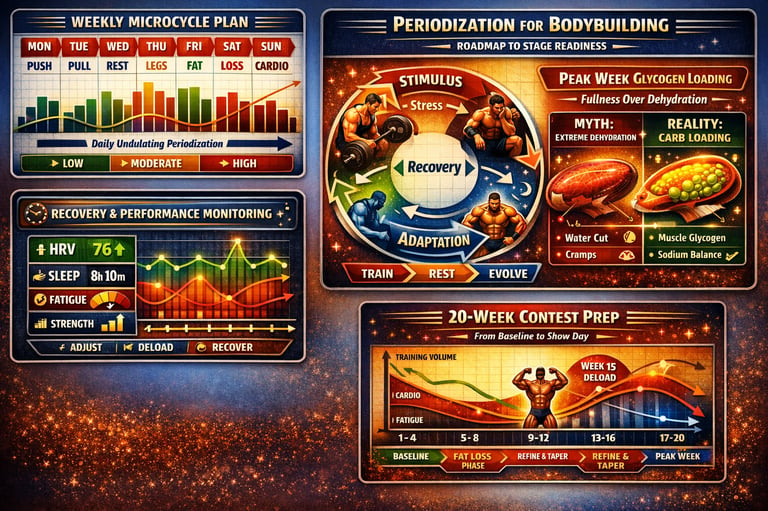
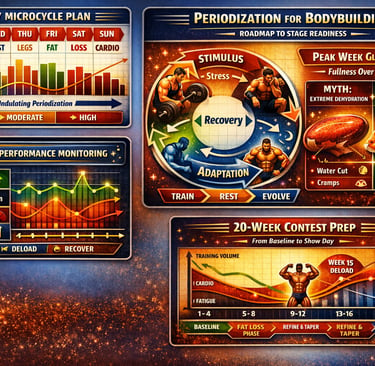
- Definition: 1-week training structure (5–10 days typical)
- Components: Split design, session frequency, daily volume/intensity, recovery placement
- Alignment: Must reflect current meso/macro phase goals
- Common Models: Push-Pull-Legs (PPL), Upper/Lower, Arnold Split, Body-Part Split
- Periodization within week: Daily Undulating Periodization (DUP) most evidence-supported
The microcycle is where programming meets reality. It’s not just “what muscles when.” It’s how volume, intensity, exercise order, rest periods, and recovery days are sequenced. DUP (varying rep ranges/intensity across days within the week) outperforms static linear models for hypertrophy and fatigue management.
Microcycle Variables & Optimization
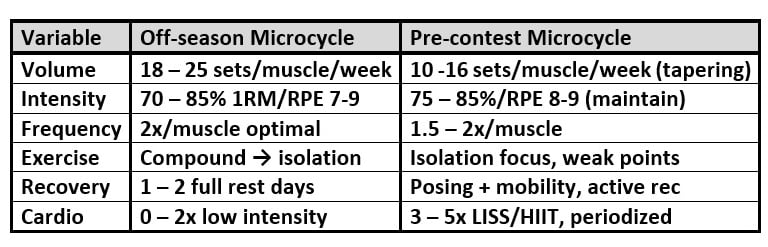
NB: RM = Repetition Maximum ; RPE = Rate of Perceived Exertion ; LISS = Low-intensity Steady State; HIIT = High-intensity Interval Training
Microcycles must adapt to phase demands. Notice how volume drops pre-contest while intensity is preserved. This maintains muscle protein synthesis signaling while reducing systemic fatigue. Exercise selection shifts from strength builders to isolation and posing-specific work. Cardio is strategically placed away from heavy lower body days to preserve recovery.
Integrating Nutrition Across Cycles
- Macro-level: Calorie targets shift with phase goals
- Micro-level: Carb/fat timing around training, intra-workout Essential Amino Acids (EAAs)/carbs, refeed days
- Protein: Consistent across phases (2.0–3.1g/kg depending on leanness/deficit)
- Hydration/Electrolytes: Periodized; sodium not cut until final 48hrs if needed
- Supplements: Creatine, caffeine, omega-3, vitamin D, magnesium (evidence-based only)
Nutrition is not separate from periodization – it is the fuel schedule. Microcycle nutrition aligns with training stress: higher carbs on heavy/volume days, lower on rest days. Refeeds are periodized every 7–14 days in prep to manage leptin, thyroid, and psychological fatigue. Consistency > perfection.
Recovery & Auto-Regulation
- Objective Metrics: HRV, resting Heart Rate (HR), sleep quality, strength maintenance
- Subjective Metrics: RPE, fatigue scales, joint pain, motivation
- Performance Checks: Pump quality, posing stamina, recovery between sets
- Deloads: Every 4–6 weeks or when 3+ fatigue markers spike
- Auto-Regulation > Rigid templates: Adjust volume/intensity based on feedback, not calendar
Periodization fails without feedback loops. Auto-regulation means modifying microcycles based on real-time data. If HRV drops 10% for 3 days, reduce volume or deload early. If strength drops >10% on key lifts, check recovery, not just programming. The best coaches periodize recovery as aggressively as training.
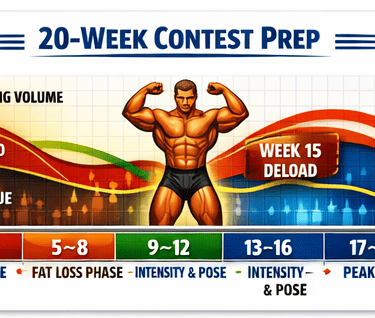
Practical Example – 20-Week Contest Prep
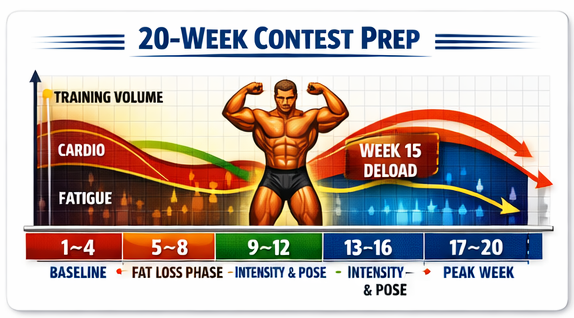
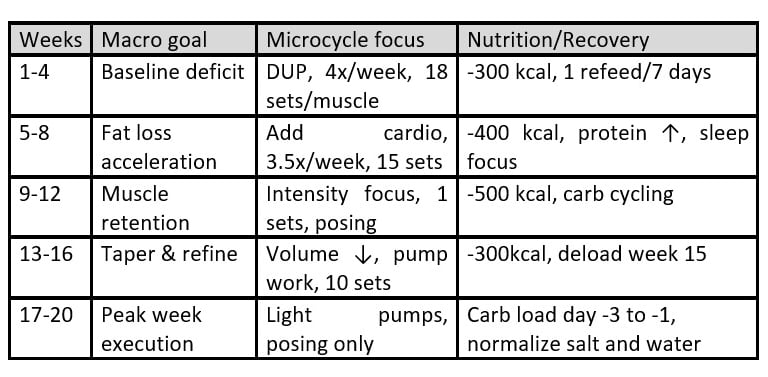
NB: DUP = Daily Undulating Periodization
This is a realistic framework for a 20-week prep. Notice the progressive volume reduction, maintained intensity, strategic cardio placement, and planned deload. Week 15 deload prevents CNS burnout before peak week. Nutrition shifts from deficit to maintenance in final week to fill glycogen. Every microcycle serves the macro goal.
Common Pitfalls & Evidence-Based Corrections
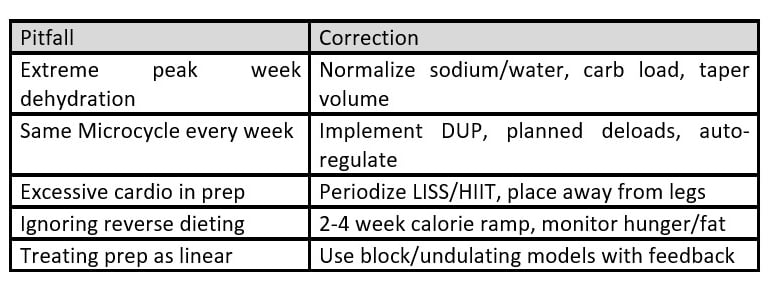
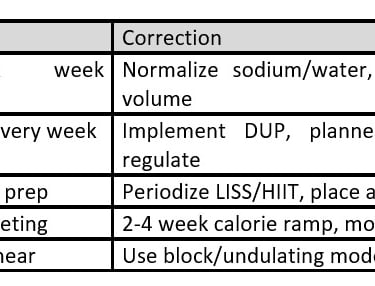
‘Bro’! Science still dominates stage prep. Extreme dehydration risks cramping, electrolyte imbalance, and flat looks. Linear programming ignores fatigue accumulation. Cardio is not a magic fat-loss tool – it is a recovery variable. Evidence consistently supports periodized, auto-regulated approaches with conservative fat loss rates (0.5–1% body weight/week).
Advanced Periodization Models in Bodybuilding
- Block Periodization: Concentrated loading and realization and recovery (ideal for weak points)
- Daily Undulating Periodization (DUP): Vary rep ranges/intensity daily within microcycle
- Conjugate Elements: Rarely used fully, but strength/hypertrophy days can coexist
- Hybrid/Flexible Periodization: Most evidence-supported; blends structure with auto-regulation
- AI & Wearables: Emerging tools for fatigue modelling, but human coaching remains irreplaceable
No single model dominates. Elite athletes use hybrids: block periodization for weak-point mesocycles, DUP within microcycles, and auto-regulation to adjust daily. AI and wearables offer promise, but periodization still requires contextual coaching. The best systems are flexible, data-informed, and athlete-specific.
Future Directions & Research Gaps
- Need for Randomised Control Trial (RCT)s in natural vs. enhanced periodization responses
- Long-term athlete development vs. short-term peaking
- Genetic/nutritional personalization algorithms
- Standardized fatigue metrics specific to bodybuilding
- Mental health & periodization integration
Bodybuilding science is maturing rapidly. We still lack large-scale trials comparing periodization models in competitors. Future work will focus on personalized fatigue modelling, mental health during extreme prep, and long-term career sustainability. Until then, evidence-informed coaching + athlete feedback remains the gold standard.
Key Takeaways
✅ Periodization is the backbone of competitive bodybuilding success
✅ Macrocycle = seasonal roadmap; Microcycle = weekly execution
✅ Balance volume, intensity, nutrition, and recovery across phases
✅ Auto-regulate > rigid templates; deload strategically
✅ Peak week refines, doesn’t rescue. Reverse diet matters.
✅ Data + coaching + consistency = stage-ready physique
If you remember one thing: periodization is not about complexity. It’s about intentional progression, planned recovery, and timing. Macro cycles set the direction. Micro cycles drive the daily work. Align them, monitor them, adjust them, and you’ll consistently peak on stage.
References (Key Resources):
- Helms, E. et al. The Muscle & Strength Pyramids: Training & Nutrition
- Schoenfeld, B. Science and Development of Muscle Hypertrophy
- Nuckols, G. & Menno Henselmans: Evidence-based prep guidelines
- Journal of Strength & Conditioning Research (2018–2025) on periodization & hypertrophy
- IFBB Pro Coaches Consensus Guidelines (2023–2025)
*Grandmaster Ajayi is based in Lagos, Nigeria and is an 8th degree 'black belter' in 'Chung-do-kwan' taekwondo. He also holds a Master’s degree in Physiology of Exercise from the University of Ibadan. He previously owned a gym called ‘Charlie's Planet Health and Fitness’ in the Ojodu Berger area of Lagos but has ceased operations therein due to circumstances beyond his control. These days, he is more of a consultant to schools, companies, the military, banks, the police, customs, as well as established fitness centres. He can be contacted by sending an email to ajayicharles23@yahoo.com . He is also reachable on Facebook and Instagram.
© 2026 The Naija Bodybuilding Directory